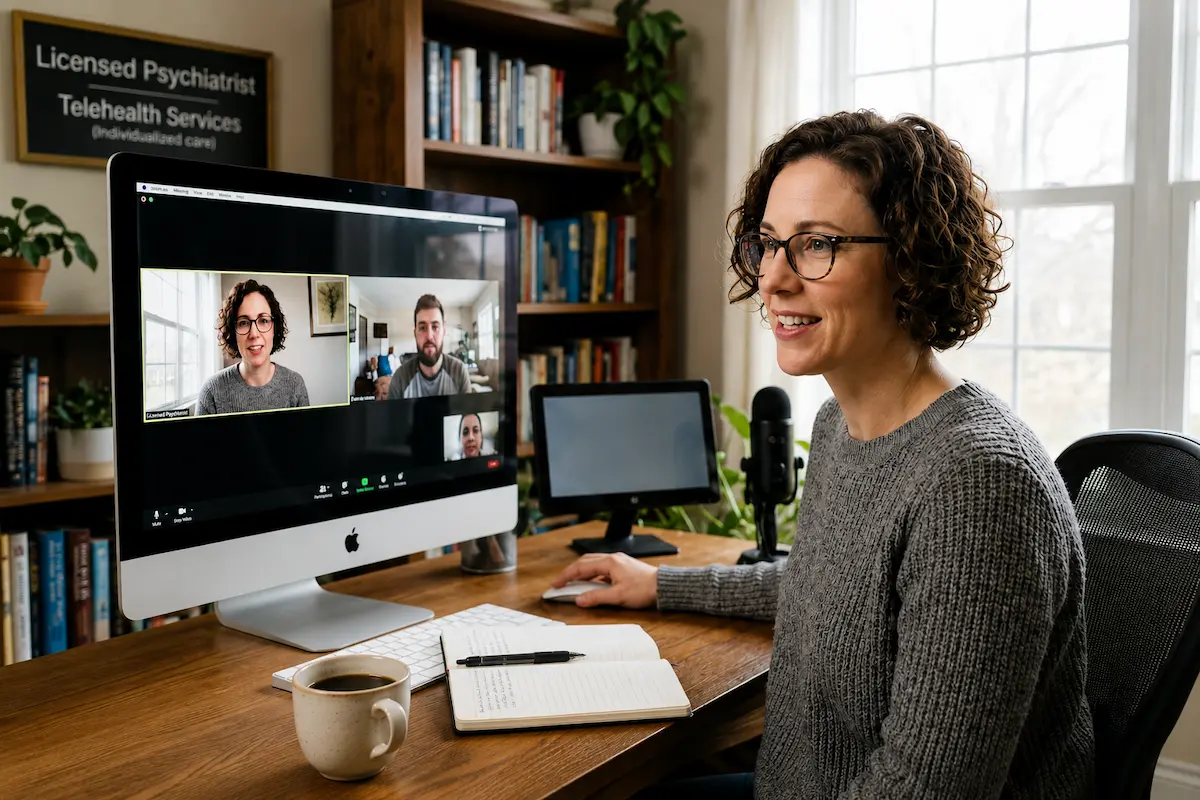
Choosing how to get help for depression is itself a decision that can feel exhausting when you are already depressed. You may be asking yourself whether a video visit can really capture what you are going through, whether insurance will behave differently, or whether you need to sit in the same room as a psychiatrist to be taken seriously. These are fair questions, and the honest answer is that both formats work well for many people and that the “right” choice depends on your symptoms, your circumstances, and your preferences.
This guide offers a side-by-side comparison of telepsychiatry and in-person psychiatry for care, drawing on current research and day-to-day clinical practice. We will cover access, effectiveness, cost, the therapeutic relationship, medication management, safety, and when each format is the better match. Resilience Psychiatry offers both modalities across New York and Florida, and our goal is to help you make a choice you feel good about.
A Quick Definition of Each Model
In-person psychiatry is the traditional format: you arrive at a clinic, sit in a private office, and meet with your psychiatrist face to face. Physical examination, observation of body language, and environmental neutrality are all part of what an in-person visit can offer.
Telepsychiatry is psychiatric care delivered through secure video (and sometimes phone) technology. Appointments are structured the same way an in-person visit would be a full interview, a mental status examination, collaborative treatment planning but they happen wherever you are physically present in a state where your psychiatrist is licensed.
Most practices, including ours, now offer both. You can start with one and shift to the other as your needs change. Our page walks through the mechanics of both formats.
Access and Convenience
For most patients, this is the category where telepsychiatry has the clearest advantage. Depression itself often makes leaving the house feel harder. Add in commuting, parking, childcare, or time away from work, and missed appointments become a real clinical problem. Inconsistent care is one of the most common reasons depression treatment stalls.
Telepsychiatry removes the geographic barrier. A patient in eastern Long Island or central Florida can see the same board-certified psychiatrist without driving, and a patient who travels for work can keep appointments consistent. Our and services were designed with this continuity in mind.
In-person visits can be better for people who find it easier to focus away from home, who live in households where privacy is limited, or who value the structure and routine of traveling to an appointment. For some patients, the act of physically leaving home and arriving at a therapeutic space is itself part of feeling better.
Effectiveness: What the Research Shows
Telepsychiatry is not a new or unproven technology. It has been studied for more than twenty years, with particularly rapid expansion and research during and after the COVID-19 pandemic. Several systematic reviews and meta-analyses including have found that for many mental health conditions, including depression, telepsychiatry produces outcomes that are broadly non-inferior to in-person care on measures such as symptom reduction, patient satisfaction, and treatment adherence.
It is important not to overstate this. “Non-inferior for many presentations” is not the same as “identical for everyone.” The evidence is strongest for mild to moderately severe depression in adults who are medically stable and not in acute crisis. It is weaker, and sometimes absent, for severely ill patients, for those with active suicidality, or for those requiring procedural treatments.
The emphasizes that successful depression treatment generally combines medication, psychotherapy, and consistent follow-up. Both formats can deliver all three.
The Therapeutic Relationship
A common concern is whether you can build the same kind of trust with a psychiatrist you have never been in a room with. The research and our own clinical experience suggests that for most patients, the answer is yes.
What matters most to the therapeutic alliance is feeling heard, understood, and taken seriously. These do not require shared physical space. Many patients report that they feel more comfortable opening up from home, especially about sensitive topics like trauma, sexuality, or substance use. Others find eye contact and physical presence more grounding.
There is no single right answer. If you know you struggle to connect through screens, in-person is a reasonable starting place. If you know that leaving the house is a major barrier to consistency, telepsychiatry may serve you better. Both formats support real, meaningful clinical relationships.
Medication Management and Monitoring
Most depression medications including SSRIs, SNRIs, bupropion, and mirtazapine can be safely started and adjusted via telepsychiatry by a licensed prescriber. Our process includes frequent check-ins during the adjustment phase, measurement-based tracking with validated questionnaires, and coordination of any needed labs at a local facility.
There are, however, specific situations where in-person care is preferable for medication management:
- Complex or high-risk regimens that require close physical monitoring, such as certain antipsychotic or lithium initiations with frequent labs and vital signs.
- Significant medical comorbidities that benefit from coordinated examination.
- Patients with a history of severe side effects who prefer in-person baseline visits.
Controlled medications are governed by federal and state rules that evolve over time. At your first visit, your psychiatrist will explain what is currently allowed in your state and how any controlled prescriptions will be handled.
Safety: When In-Person Is the Better Choice
Telepsychiatry can responsibly support most patients with depression, including those with passive suicidal thoughts, when paired with a thorough safety plan and accessible local resources. Our page lists emergency contacts and includes the for patients in acute distress.
There are presentations where in-person evaluation or a higher level of care is the safer choice:
- Active suicidality with intent or a plan, especially with access to means.
- Psychotic symptoms, such as hallucinations or delusions, that require close observation.
- Severe functional impairment that makes it unsafe for the patient to remain at home alone.
- Need for procedural treatments such as electroconvulsive therapy (ECT) or transcranial magnetic stimulation (TMS), which are delivered in person.
- Physical examination needs, particularly when depressive symptoms may be driven or complicated by an untreated medical condition.
A responsible psychiatrist, working in either format, will recognize these situations and recommend the appropriate level of care. Telehealth is a tool a powerful one not a replacement for clinical judgment.
Cost and Insurance
Cost comparisons between formats depend heavily on your insurance plan, your state, and the specific practice. In general:
- Telepsychiatry and in-person visits are often billed at similar rates by the same provider.
- Many insurers cover telepsychiatry at parity with in-person care, especially for established behavioral health services.
- Telepsychiatry may save you money on indirect costs: gas, parking, childcare, and time off work.
Resilience Psychiatry is out-of-network with most commercial plans. We provide superbills and help patients understand their out-of-network benefits so they can submit for reimbursement. Many patients are surprised to find their reimbursement rate is higher than they expected.
Hybrid Care: The Middle Path
For many patients with depression, the best answer is not “one or the other” but a thoughtful combination. A common hybrid pattern looks like this:
- A first comprehensive in person, which allows for a thorough baseline and an easier start to the relationship.
- Follow-up medication visits by telehealth, which supports consistency during the adjustment phase.
- Occasional in-person check-ins when clinically helpful for example, if symptoms worsen, if a new medication is being considered, or simply at the patient’s preference.
Hybrid care is increasingly the norm in modern psychiatry, and it works well for most mood conditions.
How to Decide What Is Right for You
A simple way to think about your own decision is to ask three questions:
1. What does my clinical picture look like?
If you are in acute crisis or experiencing severe symptoms, start with an in-person evaluation or emergency services. If your symptoms are mild to moderate and you are medically stable, both formats are reasonable.
2. What does my life look like?
If consistent appointments are hard to maintain because of distance, work, caregiving, or the depression itself, telepsychiatry meaningfully improves the odds that you will actually get treated.
3. What does my preference look like?
You are allowed to have one. Some patients simply feel more grounded in an office; others feel more honest from their own couch. Preference is a legitimate input.
There is no grade attached to this decision. What matters most is that you begin, and that your care adjusts with you.
Frequently Asked Questions
Is telepsychiatry as effective as in-person psychiatry for depression? For most adults with mild to moderately severe depression, the research supports non-inferiority — meaning outcomes are broadly comparable on standard measures. For severe, treatment-resistant, or acutely suicidal presentations, in-person evaluation and often a higher level of care are more appropriate.
Can I get antidepressants through a video appointment? Yes, with a licensed psychiatrist in a state where they are licensed. SSRIs, SNRIs, bupropion, mirtazapine, and most mood stabilizers can be prescribed via telepsychiatry. Certain controlled medications have additional requirements that your psychiatrist will review with you.
What happens if my symptoms get worse during telepsychiatry treatment? Your treatment plan will include specific steps. Depending on severity, those may include an earlier follow-up, an in-person visit, a referral to a higher level of care, or in an emergency calling 988 or going to the nearest emergency room.
Do I need a physical exam before starting antidepressants? Not always, but a recent physical and basic labs are useful, especially for ruling out medical conditions such as thyroid disease that can mimic depression. Your psychiatrist will coordinate any needed testing locally.
Can I switch between telepsychiatry and in-person care with the same psychiatrist? At Resilience Psychiatry, yes. Many of our patients use a hybrid model. You do not have to commit to one format for the life of your treatment.
Is telepsychiatry private and secure? Yes. We use HIPAA-compliant video platforms, and we ask patients to join from a private space. The clinical record is protected with the same confidentiality rules that govern in-person psychiatric care.
Get Support from Resilience Psychiatry
Whether you already know which format you want, or you would like help thinking it through, our team is here. Resilience Psychiatry provides both in-person care at our Setauket office and secure across New York and Florida. You can or call (631) 371-4844 to schedule a consultation with a board-certified psychiatrist who treats depression every day.